Elon Musk's Broken Promises & the SpaceX 401k Problem
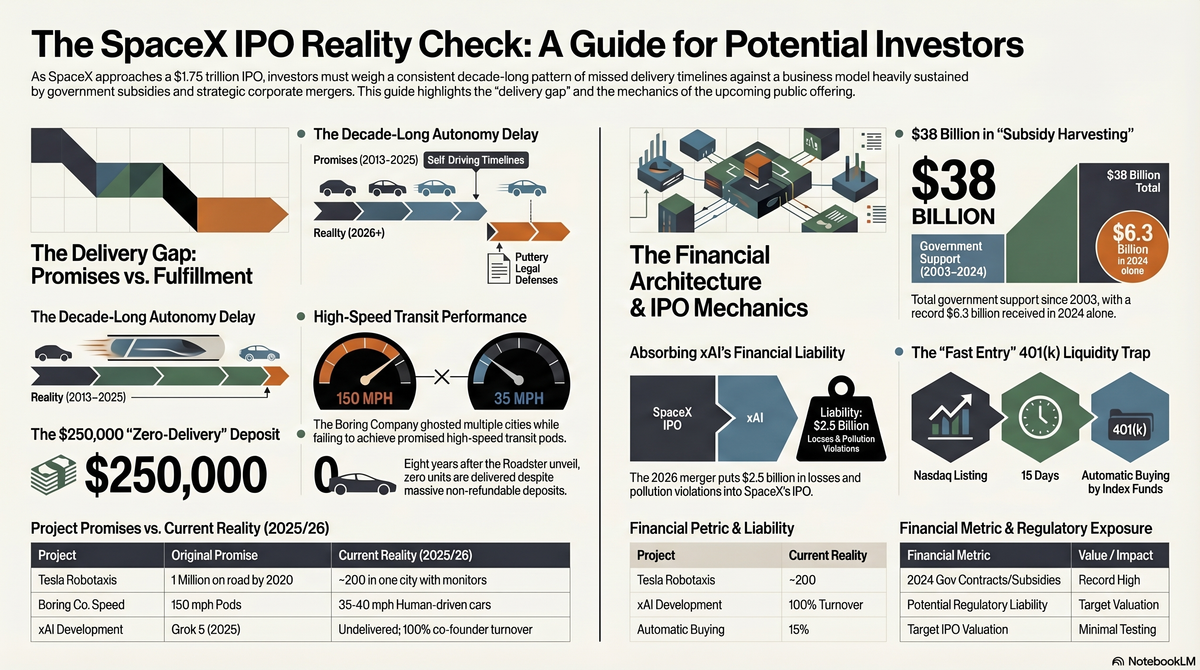
Thinking about SpaceX IPO?
Elon Musk has the most documented pattern of broken promises of any CEO alive, and the SpaceX IPO should worry everyone with a 401k.
Tesla promised a fully autonomous drive from LA to NYC by end of 2017. Then 2018. Then 2020. Every single self-driving timeline Musk gave from 2013 to 2025 was missed. His own lawyers argued in court that his predictions were "corporate puffery," legally meaning no reasonable person should have believed them. As of April 2026, Tesla has roughly 200 robotaxis operating in one city with a safety monitor sitting in the passenger seat.
The next-gen Tesla Roadster was unveiled in 2017 with deposits up to $250,000. Eight years later, not a single one has been delivered. Tesla has made it difficult to get refunds and is keeping $5,000 of cancelled deposits. Sam Altman publicly asked for his $50,000 back.
Musk promised over a million robotaxis on the road by 2020 and said they'd replace car ownership. He got a couple hundred in a geofenced Austin pilot by the end of 2025.
The Optimus robot was supposed to enter mass production in 2025. It didn't. Production is now projected for summer 2026 at the earliest, with high volume maybe by 2027.
The Boring Company promised 150 mph transport pods, $10 million/mile tunnels, and $1 rides to LAX. Eight years later, it operates 4 miles of tunnel in Las Vegas where human-driven Teslas go 35-40 mph. The Hyperloop is dead. Chicago O'Hare express never broke ground. Multiple cities — San Antonio, Ontario CA, Fort Lauderdale, Baltimore — were ghosted mid-negotiation. The pattern: whenever a city requires standard environmental review, Boring Company walks away.
His AI company xAI promised Grok 5 by end of 2025. Then Q1 2026. Then Q2 2026. It still hasn't shipped. Every year Musk predicts AGI "next year" — the same pattern as Full Self-Driving. All 11 of xAI's co-founders have left within three years. Musk admitted Grok is "not competitive with Anthropic's Claude Code or OpenAI's Codex." Meanwhile, the Colossus supercomputer in Memphis was claimed to be 1 gigawatt — satellite imagery showed only 350 MW of cooling capacity. The facility is running 35 gas turbines on a permit for 15, increasing Memphis smog by 30-60% in a predominantly Black, low-income neighborhood.
Tesla short sellers lost $40.1 billion in 2020 alone.
But here's what should concern you now:
Musk's companies have received at least $38 billion in government contracts, loans, subsidies, and tax credits since 2003, according to a Washington Post analysis entered into the Congressional record. Two-thirds of that came in the last five years. In 2024 alone, $6.3 billion — a record. Without government regulatory credits, Tesla would have lost $700 million in 2020 instead of reporting an $862 million profit. A political science professor called it a "subsidy harvesting strategy."
On Inauguration Day, Musk's companies faced 65 enforcement actions from 11 federal agencies totaling $2.37 billion in potential liability, per a Senate investigation. Then his DOGE went after those same agencies. The NHTSA team regulating autonomous vehicles — with 6 open Tesla investigations — was cut nearly in half. The FAA was gutted while SpaceX faced safety violation penalties and a rocket explosion probe. The CFPB was slashed as X moved into financial services. FDA workers reviewing Neuralink were cut. The SEC and DOJ are both investigating whether Tesla overstated its self-driving capabilities. Senate Democrats accused Musk of using DOGE to "evade oversight, derail investigations, and make litigation disappear."
In February 2026, SpaceX acquired xAI in an all-stock deal valued at $1.25 trillion combined. That means xAI's $2.5 billion in losses, its regulatory exposure from deepfake lawsuits, and its Memphis pollution violations are now inside the company heading for the biggest IPO in history.
SpaceX is targeting a $1.75 trillion IPO — possibly as early as June 2026. Nasdaq just created a "Fast Entry" rule, effective May 1, 2026, that lets mega-cap IPOs join the Nasdaq-100 index within 15 days. Reuters reported SpaceX demanded this rule as a condition for listing. Once it's in the index, every fund tracking the Nasdaq-100 automatically buys it. That includes the target-date funds in your 401k. Acadian Asset Management called this turning "passive 401(k) investors into exit liquidity."
Let the public record speaks for itself.
Invest wisely.