The FAA Ground Stop: What the Briefing Left Out
The equipment really is old. But a network change likely triggered the crash, the FAA was warned, and the $50 billion ask has no breakdown behind it.
On Friday, November 13, the FAA halted every departure in the country for more than four hours. It was only the second nationwide ground stop since 9/11, and far longer than the first. That night, Transportation Secretary Sean Duffy and Homeland Security Secretary Markwayne Mullin blamed decades-old equipment and asked Congress for $50 billion.
We checked 24 claims from that briefing against the public record. The core holds. The framing around it does not.
What holds up
The equipment that failed is old. Senior government sources told CBS News the preliminary finding points to Cisco routers built between 2001 and 2006; an FAA-commissioned review called the agency's telecom network obsolete in 2023. Every aircraft landed safely. Congress also kept the FAA's equipment budget near $3 billion a year for about 15 years, under both parties. And Duffy is right that new money now needs Democratic votes.
What the briefing left out
The trigger. Multiple sources told CBS that an update to the network caused it to reboot and crash, though CBS also notes conflicting accounts. Mullin said on camera that FAA patches and new equipment were "overwhelming the older system." Asked directly, Duffy talked only about old hardware. No official cause has been announced.
The warnings. The 2023 review predicted more telecom outages "due to an underfunded migration to IP-based telecommunications." In March 2025, the air traffic controllers' union testified to Congress under the heading "The FAA's Looming Telecommunications Crisis." Duffy said, "I didn't anticipate that we would have an outage like this."
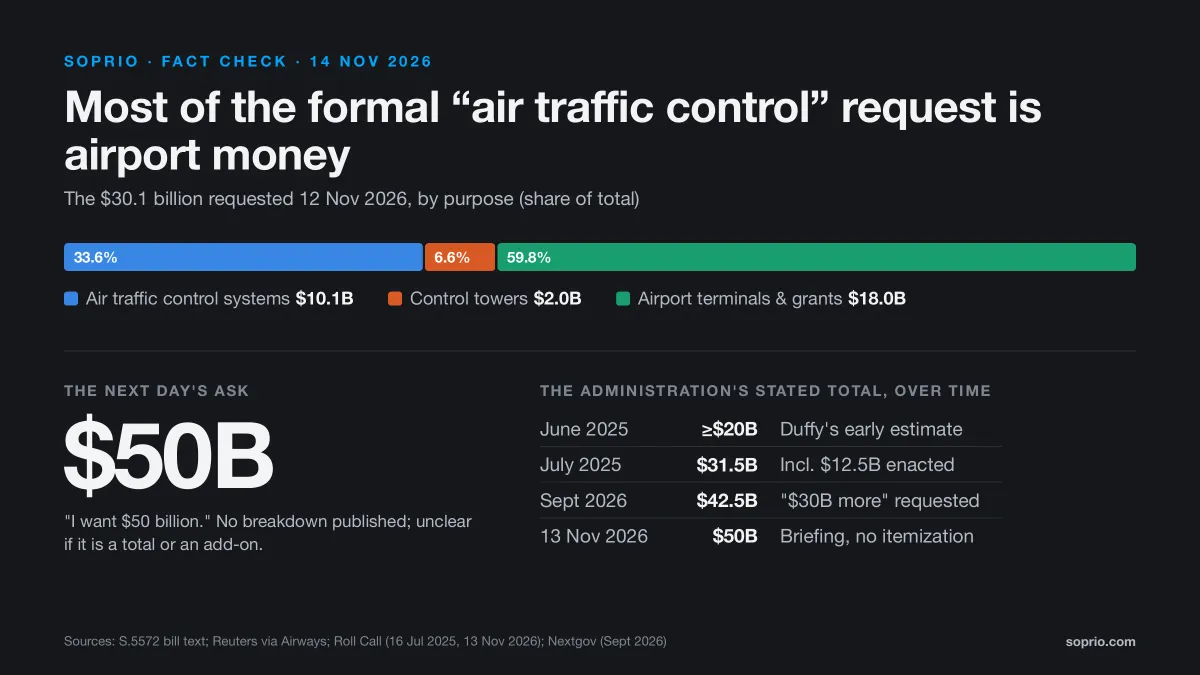
The money. We found no official document using the $50 billion figure before that night, and Roll Call reports officials "didn't fully flesh out" the number. The formal request, sent a day earlier, was $30.1 billion, and $18 billion of it is for airport terminals and airport grants, not air traffic control. The stated total has climbed from at least $20 billion in mid-2025 to $31.5 billion, then $42.5 billion. Now it is $50 billion, with no word on whether that is a total or an addition.
Congress. Duffy repeatedly blamed lawmakers. Yet Congress gave the FAA's equipment account its full 2026 request, and the President's own 2027 budget sought no additional money for the new system through regular appropriations. The formal request arrived November 12, nine days after Democrats won both chambers.
The workforce. The 2025 DOGE-era firings did not reach controllers or the technicians who maintain this equipment. But the FAA's own 2026 plan counts 4,594 certified technicians against a target of 5,300 and warns of "reduced equipment availability and reliability." No evidence yet ties staffing to Friday's failure.
Two smaller claims also failed: towers are not "almost a hundred years old" (the oldest are about 70), and we found no record of a presidential "national emergency" declaration as of November 14.
Bottom line
The equipment really is old, and replacing it will cost real money. But a network change likely triggered the crash, the FAA had been warned, and the newest price tag has nothing behind it. In September, government auditors found the FAA has no reliable cost estimate for this overhaul. The public deserves an itemized number before Congress signs a $50 billion check.
The six-page PDF rates all 24 claims and links every finding to its source, 63 in all.
Ratings apply to claims, not to the people who made them. This analysis was researched and drafted with Claude, an AI model made by Anthropic, under Soprio's editorial direction. AI can make mistakes, including in quotes and citations, so every finding in the PDF links to its source. Findings are current as of midday ET, November 14, 2026; the official root cause and any emergency declaration could change them. Version 1.0.